


2026
Cross-Border Solutions: Moving Goods Between Ontario and the US Without Stalling at the Border
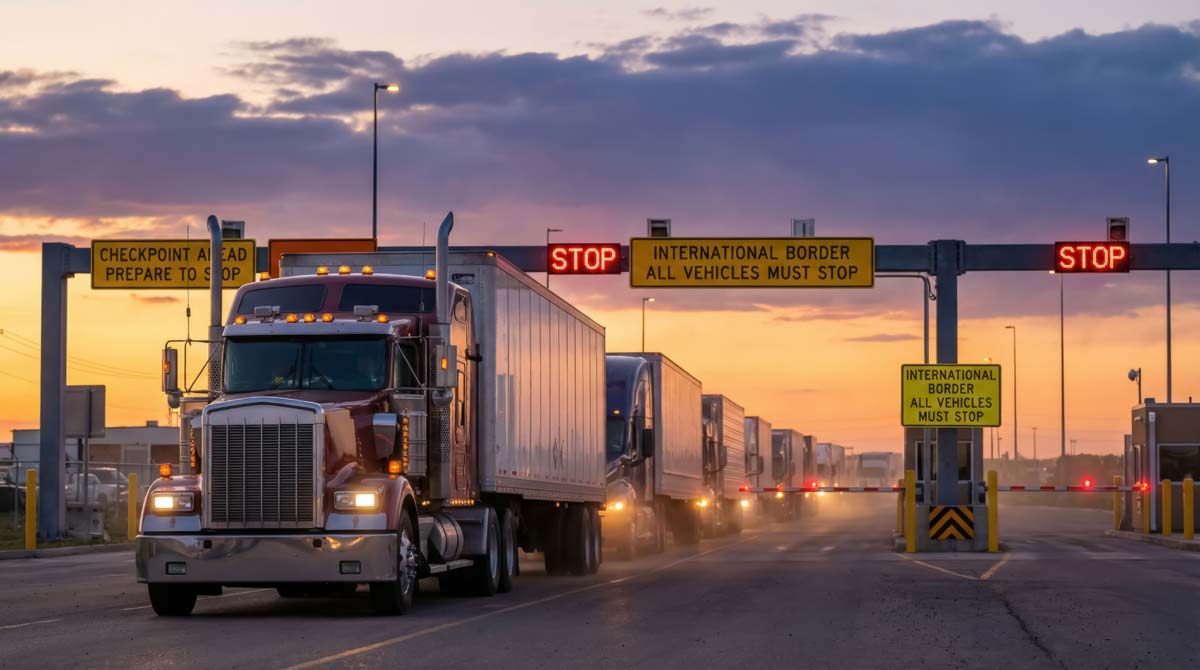
Ontario sits closer to the American industrial heartland than anywhere else in Canada, and the border is the single largest variable in any supply chain that crosses it.
Most delays at that border are not caused by enforcement. They are caused by paperwork, timing and equipment decisions made days earlier. Here is where the friction actually comes from.
Documentation is the usual culprit
The overwhelming majority of border holds trace back to documentation that was incomplete, inconsistent, or arrived after the freight did.
Commercial invoices with vague product descriptions, tariff classifications that do not match the goods, mismatches between the manifest and the physical load, and missing certificates for regulated commodities all produce the same outcome: a shipment sitting while someone sorts it out. Freight moving in either direction is subject to the same principle, and the fix is always upstream rather than at the crossing.
Timing decisions that cost hours
Crossing times vary enormously by port and by hour. A load routed through a crossing at its busiest period can lose a significant part of a day for no reason other than scheduling.
Experienced cross-border operations plan the crossing rather than simply driving toward it, accounting for known congestion patterns, the customs broker’s hours, and the receiving window at the other end. A truck that clears at three in the morning and then waits until eight for a receiver has not gained anything.
Where a Canadian facility changes the equation
For American companies serving Canadian customers, and Canadian companies serving American ones, the choice is between shipping every order across the border individually or holding inventory on the far side and distributing domestically.
The second approach means one customs event rather than many. Freight crosses in bulk, clears once, and is then distributed within the country using domestic transport. It reduces the number of opportunities for something to go wrong by an order of magnitude, and it removes border unpredictability from customer delivery promises. That is the practical argument for cross-border solutions built around a warehouse rather than around a carrier.
Bonded and sufferance status
For imported freight that has not been released, the receiving facility has to be authorized to hold it. Bonded warehousing allows goods to be stored with duties and taxes deferred until they are released for Canadian consumption, or exported without those duties ever applying.
That capability matters for two reasons. It provides working capital flexibility for importers. And it gives you somewhere legitimate for freight to go when a clearance is taking longer than expected, rather than the freight becoming a problem in transit.
What to sort out before the first crossing
Companies setting up a cross-border lane for the first time should have the following settled in advance:
- Who your customs broker is on each side, and how they receive documentation
- Tariff classifications confirmed for every product, before the first shipment
- Which party is the importer of record, and who bears duties
- Whether any of your products require permits, certificates or agency approvals
- Whether your carrier is a bonded carrier where the freight requires one
- Realistic transit expectations that include crossing time, not just driving time
- A plan for what happens if a shipment is held
That last item is worth more than it appears. Every cross-border operation eventually has a shipment flagged, and the difference between an inconvenience and a crisis is whether anyone thought about it beforehand.
Containers and consolidation
For companies importing from overseas and distributing into both countries, the Toronto area works well as a single point of entry and separation. Freight arrives, container destuffing happens at the facility, and outbound loads are built for Canadian and American destinations separately, each with the right documentation.
Talk to our Toronto team
18 Wheels operates 350,000 square feet across Mississauga and Brampton with 24/7 operations, 76 loading docks and bonded capability, positioned for both Ontario distribution and cross-border movement. Call 416-316-6103 or get in touch to talk through your lanes.