


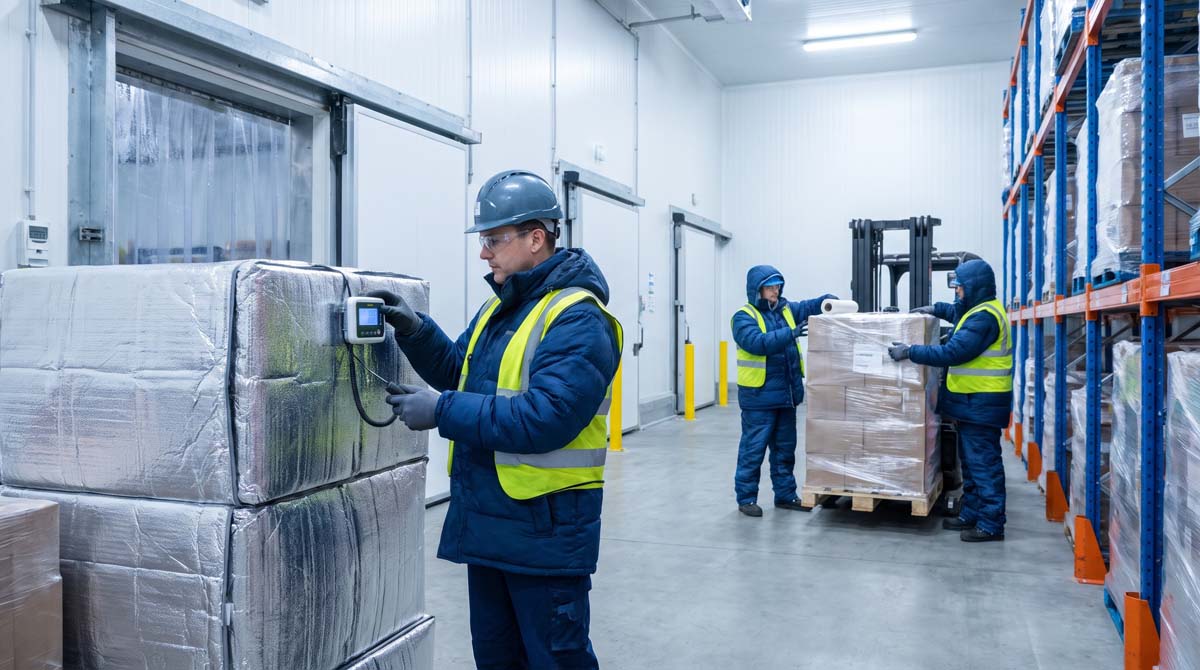
The costs of that arrangement are mostly hidden. Three inventory records, three sets of paperwork, three receiving processes, and a retailer order that has to be assembled from three buildings and arrive as one delivery. Multi-temperature warehousing exists to collapse that back into one operation, and the argument for it is less about refrigeration than about not splitting your inventory.
The Bands, and Why Products End Up in the Wrong One
Food storage divides into a small number of temperature bands, and the boundaries matter more than brands expect.
Ambient is the ordinary dry warehouse, suitable for shelf stable packaged goods. Controlled ambient is a tighter version that holds a range rather than simply being indoors, which matters for chocolate, oils, supplements and anything that degrades at the top of a summer temperature range. Cool and chilled storage covers fresh product, dairy and much of the prepared food category. Frozen is its own band with its own equipment.
Products end up in the wrong band for a predictable reason: the label states a storage condition that is more permissive than what actually preserves quality through a full distribution cycle. A product that is technically shelf stable can still soften, separate, lose colour or shorten its effective life sitting at the top of an ambient range through an Ontario August. The question is not only what the product tolerates, but what condition it needs to arrive in to look right on shelf.
What Running Across Several Providers Actually Costs
The split is expensive in ways that do not show up as a line item.
Inventory accuracy suffers, because there is no single record and reconciling three is nobody's job. Minimums apply separately at each provider, so a brand pays three times for being small. Receiving happens three times for one inbound purchase order, which means three chances for a count discrepancy. And when a retailer orders across the catalogue, somebody has to coordinate three shipments to arrive at one receiving appointment, which is the step that most often fails.
There is a traceability cost as well, and it is the one that matters in a recall. Tracing a lot in both directions within hours is considerably harder when the records sit in three systems operated by three companies.
What Consolidation Buys
Running the whole catalogue through one multi-temperature operation changes several things at once.
A single inventory record covers every item regardless of its storage condition, which means stock positions are actually knowable. One receiving process handles the inbound. Mixed orders are picked across bands and consolidated onto one shipment, with one bill of lading and one delivery appointment. Minimums apply once. And a trace runs across the entire catalogue in one system rather than being assembled from three.
The practical effect shows up most clearly at the retail door. A buyer who ordered across your range receives one delivery, on time, complete. That is the measure most retail scorecards actually track, and it is very hard to hit consistently when the order is being assembled from separate buildings. Food grade warehousing that covers the full range of a catalogue is what makes it routine.
Where the Cold Chain Actually Breaks
Temperature excursions rarely happen in the storage area. They happen at the transitions, and knowing where they are tells you what to ask about.
A trailer that was not pre-cooled before loading. Product staged on a dock while a trailer is positioned. A dock door open to outside air in August or in February. A gap between a trailer and a dock seal. A transfer between vehicles partway through a journey. Any of these can take product out of range for long enough to matter, and none of them are visible afterwards.
What protects against them is specific and worth asking about directly: continuous monitoring rather than spot readings, alarms that reach a person rather than a log file, backup power, a documented response procedure for an out-of-range reading, dock seals and airlocks, pre-cooling as standard practice, and records retained long enough to answer a question months later.
Beverage is where this bites soonest in Canada, because freezing is as much a risk as heat. Product left in an unheated trailer in January is damaged as surely as product left in the sun. Beverage storage and distribution has to account for both ends of the range, not just the top.
What to Ask a Multi-Temperature Provider
Facilities describe their capability loosely, so the useful questions are specific:
- Which temperature bands are actually maintained on site, with the range for each stated as numbers
- Whether the certification scope covers every band or only part of the building
- How temperature is monitored, how often it is logged, and who receives an alarm at two in the morning
- What backup power covers, and how long it runs
- Whether orders can be picked across bands and consolidated onto one shipment
- How lot codes and expiry dates are tracked, and whether rotation is enforced first expired first out
- What the last mock recall trace time was, measured in both directions
The recall exercise is the most informative request on that list, because it tests the lot records, the inventory control and the shipping documentation at the same time. A provider who can produce last year's with a trace time attached is demonstrating the whole system.
Certification Is Necessary and Not Sufficient
Most Canadian grocery buyers now expect a facility certified under a scheme recognised by the Global Food Safety Initiative, and SQF is the one most commonly held here. It will usually be asked about during vendor approval.
What a certificate does not tell you is temperature capability. A facility can be fully certified for ambient storage and be entirely unsuitable for chilled product. Those are separate questions and both need their own answers. Read the scope on the certificate: it names the site and the activities covered, and a certificate for storage and distribution does not extend to repacking.
It is also worth confirming what else can happen in the building, since food brands almost always end up needing more than storage. Cross-docking for pre-sold volume, repacking into retail configurations and labelling all avoid a freight leg when they happen where the inventory already sits.
Talk to Our Toronto Team
18 Wheels has been warehousing, co-packing and moving freight for Canadian businesses since 1989, with Toronto area operations in Woodbridge, Mississauga and Brampton and a network across the country, working to GMP standard with SQF and HACCP certification and bonded capability.
Tell us what your catalogue looks like, which items need what conditions and who you ship to, and we will tell you honestly which bands we can hold and which we cannot. Call 416-316-6103 or get in touch.